Royal Birkdale rarely gives anything away cheaply, and for the 154th Open Championship between 16 and 19 July it did not need to. The weather did the unexpected work instead. Thursday opened at 28°C under a mostly clear sky, with the wind sitting between eight and fourteen miles per hour and gusting to twenty, and the temperature then eased gently through the week to around 23°C by the time Ryan Fox birdied the last on Sunday to win his first major at ten under par. There was no significant rain across the four days. For an Open on the Lancashire coast, this was close to an aberration.
That matters more to the apparel story than it might first appear. The default visual language of an Open is waterproof: shells zipped to the chin, trousers darkened from the knee down, gloves swapped between shots. Take that away and the clothing has nowhere to hide. What is left is cut, colour and the fit of a polo across the shoulders through a full turn. In a field of 156 players over the eleventh Open staged at Birkdale, the wardrobes that held up under that scrutiny were the ones built on structure rather than weather-proofing.
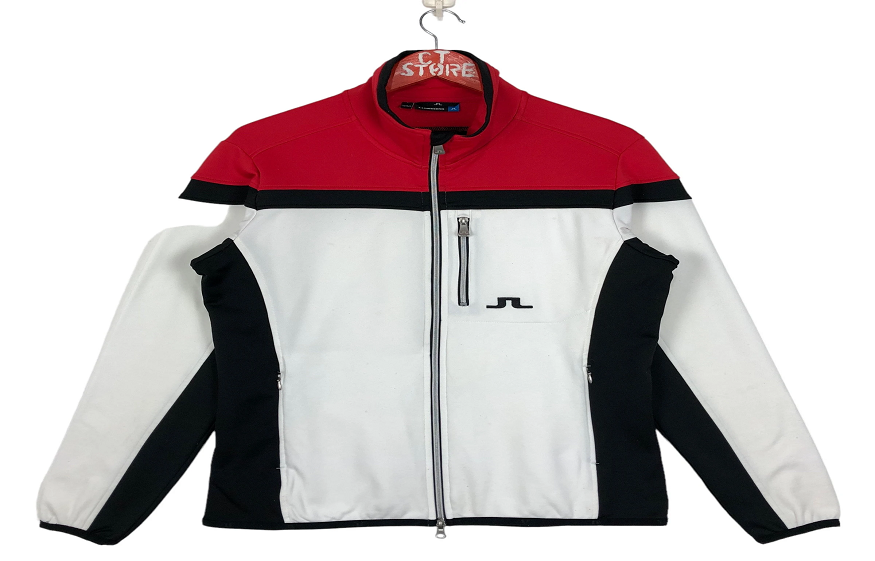
Viktor Hovland’s was among them. The Norwegian arrived in J.Lindeberg, as he has for most of his professional career, and the scripting told a small, deliberate story across the week: a lavender polo on Thursday, then a shift into brindle and black as the tournament tightened over the weekend. Geometric shapes, technical fabric, and a palette that moved in one direction only. It is a compact illustration of how a Scandinavian design house thinks about a golf tournament, and why that thinking has aged unusually well. For golfers in the UK who want to work from the same vocabulary, the brand’s collections are available through Function18.
The grammar of Scandinavian design
Scandinavian design is often reduced to a mood board of pale wood and empty rooms, which does it no favours. The more useful description is a set of working rules: form follows use, ornament earns its place or is removed, and a limited palette is treated as a discipline rather than a limitation. Nothing in that list is about looking cold. It is about editing.
J.Lindeberg has applied those rules to golf clothing since the late 1990s, and the geometric shapes recurring through its collections are the clearest expression of them. A block, a band, a repeated angle across a chest or down a sleeve is a graphic decision with structural logic behind it. Panels sit where the garment needs a seam. Colour blocking follows the line of a shoulder rather than fighting it. The result reads as design rather than decoration, a distinction that survives close television coverage far better than a print applied at random.
That editing instinct was visible in the way Hovland’s week was assembled, and it is the reason the brand translates so readily to club level. Function18 stocks the collections these principles run through, which makes the approach available to ordinary golfers rather than restricted to tour scripting.
Lavender on Thursday, brindle and black by Sunday
Thursday at Birkdale was the warmest and brightest day of the championship. A lavender polo in that light behaves quite differently from the same garment under the flat grey of a typical July on the Sefton coast. Soft mid-tones tend to disappear under cloud; in direct sun they hold their value and read cleanly against the fairway and the dune grasses that frame it. Lavender is also a colour golf apparel has historically kept at arm’s length, filed alongside the pastels the game’s more conservative wing has always regarded with suspicion. Worn as a single flat shade with a clean collar and minimal branding, it sheds that association entirely.
The technical side was doing work as well. At 28°C in a light coastal breeze, a polo has to move moisture quickly and hold its shape while doing it, and warm-weather Opens are where the gap between a technical polo and a merely smart one becomes obvious by the back nine. Through J.Lindeberg at Function18, golfers can find the same fabric platforms across a wide spread of colourways.
By the weekend the scripting had moved into brindle and black. Brindle is an interesting choice of tone as well as of word: a streaked, tawny brown sitting somewhere between the sand of a links bunker face and the colour fescue takes on after a dry spell. It is drawn from the landscape rather than imposed on it, and paired with black it produces a look that is serious without being severe. The arc is easy to read, and scripting teams across the sport now use it routinely — open the week with something distinctive, then compress the palette as the tournament nears its conclusion.
What separates this from the generic weekend blackout is that the geometry remains. The shapes stay in place; only the colour drops out. That is harder to design than it sounds, because it requires a garment’s structure to be interesting enough to carry a tonal outfit on its own.
Read More: The Best Times of Year to Marry in Spain (and the Months to Avoid)
Holding a position between two camps
Golf apparel has spent the past decade sorting itself into two camps. On one side sit the pure performance brands, where the fabric story leads and the aesthetic follows from it. On the other sit the heritage labels, where the visual codes of the game — pique cotton, tipped collars, argyle — are the product, and technical claims are secondary.
J.Lindeberg has never been comfortable in either camp and has built something durable out of that discomfort. The clothing is unambiguously technical, but it is designed with the confidence of a fashion house rather than the caution of a sportswear supplier. It borrows from streetwear silhouettes without becoming a costume, and it respects golf’s dress conventions without treating them as sacred. That middle ground is narrow, and it is telling how few brands have managed to occupy it for as long.
The Scandinavian comparison worth drawing is with Galvin Green, the Swedish house that approaches the same climate from the opposite end: engineering first, styling second, and a reputation built on keeping golfers dry in conditions Birkdale declined to produce this year. Between them, the two describe the full width of what Scandinavian golf clothing does, and both sit alongside one another at Function18.
Why restraint suits links golf
There is a natural fit between an edited design language and links golf that goes beyond coincidence. Links courses are themselves exercises in restraint. The architecture is largely inherited from the ground rather than imposed on it, the palette is a narrow band of greens, browns and greys, and the interest comes from contour and wind rather than from anything decorative. A course designed by subtraction pairs naturally with clothing designed the same way.
There is a practical dimension too. Links golf demands a wide range of movement — low punched shots, awkward stances on slopes, full-blooded swings into a coastal breeze — and it punishes anything that flaps, rides up or restricts a turn. Clean lines and considered panelling are not only an aesthetic position; they describe a garment that stays where it was put across four rounds.
That combination is why a warm, dry Open was such a useful showcase. Stripped of the waterproofs that usually dominate the championship’s visual record, what remained was the base layer of a player’s wardrobe, and the brands with a coherent philosophy were the ones that looked composed. Function18 offers golfers access to those collections, chosen over two decades for a UK network of players who know what a north-westerly does to a badly cut polo.
Read More: The Ultimate Blueprint for Buying Premium Graphic Tees
What Birkdale left behind
Ryan Fox’s championship will be remembered for a 62 on Saturday and a birdie at the last, and rightly so. But Opens leave other, smaller impressions, and one of the 154th’s was how well a disciplined approach to clothing held up when the weather refused to provide the usual drama. There was nowhere to shelter behind a shell jacket. The clothing simply had to work.
Hovland’s week — lavender to brindle and black, geometry constant throughout — was a neat demonstration of what a coherent design language looks like in practice. It was not loud, it did not chase attention, and it gave the impression of having been settled well in advance rather than assembled on the morning of each round. That is the Scandinavian argument in miniature: fewer decisions, made better, and then left alone.
The transferable lesson for the club golfer is not the specific colours but the method. A small, considered range of pieces that share a visual logic will always look more assured than a wardrobe accumulated one impulse at a time. Function18 has spent twenty years assembling collections along those lines, bringing designer and technical golf labels together for players who would rather their clothing were a settled question than a weekly one.
The 154th Open gave the game a rare thing: four days on the Lancashire coast in which the golf, and the clothing, could be seen clearly. On that evidence, restraint travels well.